 Ferndale
 Building Decks for Kendall's Climate
Kendall sits back from the water, up toward the foothills along the Mount Baker corridor, but it doesn't escape what Whatcom County weather does to outdoor wood structures. Between the tree cover, the elevation, and the long stretch of wet months that run from October through May, decks out here take on moisture in ways that decks in drier parts of the state simply don't. Add in the region's broader marine-influenced pattern — the same driving rain and salt-tinged air that works its way inland off the Salish Sea — and you get a climate that's genuinely tough on anything built with wood, fasteners, and ground contact.
A deck that looks fine the first summer can start showing problems by year three if it wasn't built with this climate in mind: soft spots near ledger boards, green film on the boards by April, rust bleeding from screw heads, railings that wobble because a post base never had a chance to drain. None of that is inevitable. It's mostly a function of how the deck was framed, flashed, and fastened in the first place.
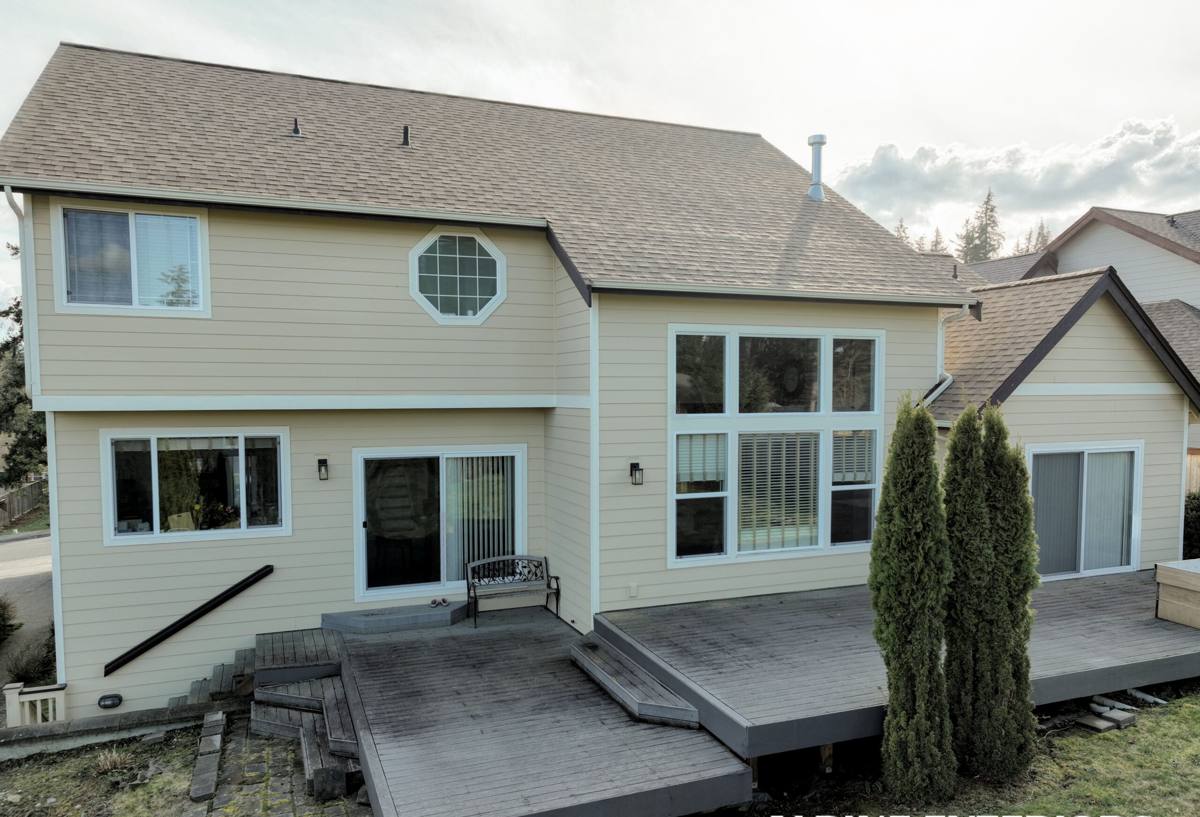
What Local Homes Actually Need From a Deck
A deck built for Kendall needs to handle three things well: constant moisture, heavy shade in a lot of yards, and the freeze-thaw swings that happen when a wet fall gives way to a cold snap. That means paying attention to details that don't matter much in a dry climate but matter a great deal here.
Drainage First, Always
Standing water is the single biggest cause of premature deck failure in this part of Whatcom County. Board spacing, joist slope, and what's happening underneath the deck all need to move water away from the structure instead of trapping it. A deck built tight to the ground with no airflow underneath will hold moisture against the framing for months at a time.
Shade and Moss
Many Kendall properties sit under mature fir and cedar cover, which is great for privacy and terrible for a deck surface that never fully dries out. Moss and algae don't just look bad — they hold water against the decking and turn boards slick and dangerous underfoot. Material choice and board orientation both affect how much of a problem this becomes.
Ground Contact and Footings
Saturated soil around footings is common here for a good chunk of the year. Footings need to be sized and set below frost depth with proper drainage gravel, not just poured into whatever hole happens to be convenient. This is one of the areas where cutting corners doesn't show up right away — it shows up in year four or five as a deck that's started to lean.
Decking Material Options, Honestly Compared
There's no single "best" decking material — there's a best fit for your budget, your yard's sun and shade, and how much upkeep you actually want to do. Here's how the common options hold up specifically in this kind of wet, shaded, moss-prone environment.
| Material | How it handles this climate | Maintenance | Rough lifespan |
|---|---|---|---|
| Pressure-treated wood | Affordable and strong, but absorbs moisture readily; needs sealing to resist rot and moss | Annual cleaning and re-sealing | 10-15 years with upkeep |
| Cedar | Naturally rot- and insect-resistant, ages to a silver-gray patina; still needs care in shaded, damp spots | Periodic cleaning, optional staining | 15-20 years with upkeep |
| Composite decking | Doesn't absorb water or rot; some early-generation composites held surface moisture and grew moss faster than expected | Occasional washing, no sealing or staining | 25-30 years |
| PVC/capped composite | Fully sealed surface sheds water and resists moss and mildew best of the group | Occasional washing | 25-30+ years |
We don't push composite or PVC decking on every job — a well-built cedar deck that's cleaned and sealed on schedule can look great for two decades in this climate. What we won't do is install a decking product without being upfront about what it actually requires to hold up here, because a homeowner who wasn't told about the maintenance schedule is the one who ends up unhappy with the material three years in.
Framing and Fastener Choices That Matter Here
The framing and hardware underneath a deck do more work than the decking boards themselves, and they're also what's hardest to fix later. This is where we don't cut corners, because it's not visible until something fails.
- Ledger board flashing that properly sheds water away from the house rim joist, not just a bead of caulk
- Hot-dip galvanized or stainless structural hardware — standard hardware corrodes faster in this humidity
- Joist tape or flashing on top of every joist to stop water from wicking into end grain
- Post bases that hold posts above standing water instead of embedding them directly in concrete
- Proper footing depth and drainage gravel so frost heave and saturated soil don't shift the structure
- Fasteners rated to match the decking material, especially with composite and PVC boards
Skimping on any one of these usually doesn't show up on the final walkthrough. It shows up as a soft ledger board or a rust-streaked railing bracket a few winters later.
Railings, Stairs, and Hardware in a Wet Climate
Railing posts and stair stringers take on more direct weather exposure than the deck surface, since rain hits them from the side and they don't always dry between storms. We size posts and connections above code minimums where the design allows for it, and we specify fasteners and brackets rated for exterior, high-moisture use rather than standard interior-grade hardware. Cheap screws and brackets are one of the most common places we see corrosion show up first on decks we're asked to repair, usually within the first few winters.
Our Deck Building Process
1. On-Site Assessment
We walk the site with you, look at drainage, sun and shade exposure, and how the deck will tie into the house, and talk through what you actually want to use the space for.
2. Design and Material Selection
We lay out size, layout, and material options with real numbers attached, including honest maintenance expectations for whatever decking you choose.
3. Permitting
Deck projects in unincorporated Whatcom County generally require a building permit depending on size and height. We handle that process rather than leaving it for you to sort out.
4. Construction
Footings, framing, flashing, decking, and railings, built in that order with inspections at the points that matter — not rushed to get to the finish work.
5. Final Walkthrough
We go over the finished deck with you, including what maintenance it needs and roughly when, so there are no surprises down the road.
Deck Maintenance Checklist for This Climate
Whatever material you choose, a few habits make a real difference in how long a Kendall deck lasts:
- Sweep debris and needles off the surface regularly — trapped organic matter feeds moss and holds moisture
- Clean the deck surface at least once a year to remove algae and moss before it gets established
- Check under the deck once a year for standing water or blocked drainage paths
- Inspect ledger flashing and railing connections for rust streaks or loose hardware
- Reseal or restain wood decking on the schedule the manufacturer recommends, not "when it looks bad"
- Trim back overhanging branches where possible to cut down on shade and debris buildup
What a Cost Estimate Depends On
| Factor | Why it affects cost |
|---|---|
| Size and shape | More square footage and complex layouts mean more material and labor |
| Height above grade | Taller decks need more substantial framing, footings, and stair runs |
| Material choice | Pressure-treated, cedar, composite, and PVC all sit at different price points |
| Site access and slope | Sloped or hard-to-access lots, common around Kendall, add labor time |
| Railings and features | Custom railings, built-in seating, or multi-level designs add cost |
We give real, itemized numbers based on your actual site rather than a generic per-square-foot figure, because the factors above can move a project's cost significantly in either direction.
Why Hire a Crew That Already Works in Kendall
Building a deck that lasts here isn't about following a national how-to guide — it's about knowing how this specific stretch of Whatcom County behaves across a full year. We've seen what happens to decks built without proper flashing once the fall rains set in, and what happens to footings poured without enough drainage gravel once the ground saturates. That experience shapes how we build every deck, not just what we tell you afterward went wrong on someone else's job.
We're also familiar with Whatcom County's permitting process for outdoor structures, which saves time compared to a crew working in the area for the first time. And because we're local, we're the ones who answer the phone if something needs a look five years from now — not a call center for a company that moved on to the next region.
If you're planning a new deck or replacing one that's past its prime, we're happy to come take a look and give you a straightforward, no-pressure estimate. Use the form below to get started.