 Ferndale
 Why Bellingham's Climate Is Hard on Siding
Bellingham sits on Bellingham Bay, and that proximity to Puget Sound saltwater changes what siding has to survive here compared to a home fifty miles inland. Salt-laden air corrodes fasteners, breaks down cheap coatings, and accelerates wear on anything not built to handle it. Add in Whatcom County's driving rain — the kind that comes in sideways off the water during fall and winter storms — and you have moisture finding its way into every gap, seam, and fastener hole that wasn't sealed correctly the first time.
Then there's moss. The long, wet, mild season here means north-facing walls, shaded elevations, and anywhere airflow is restricted stay damp for months at a stretch. Moss and algae don't just sit on the surface — they hold moisture against the siding, and on materials that aren't moisture-stable, that constant dampness is what starts rot, delamination, or paint failure years before it should happen.
None of this makes Bellingham a bad place to own a home. It just means the siding has to be chosen and installed with this specific climate in mind, not a generic install job that would hold up fine in a drier region but starts failing here in five or ten years.
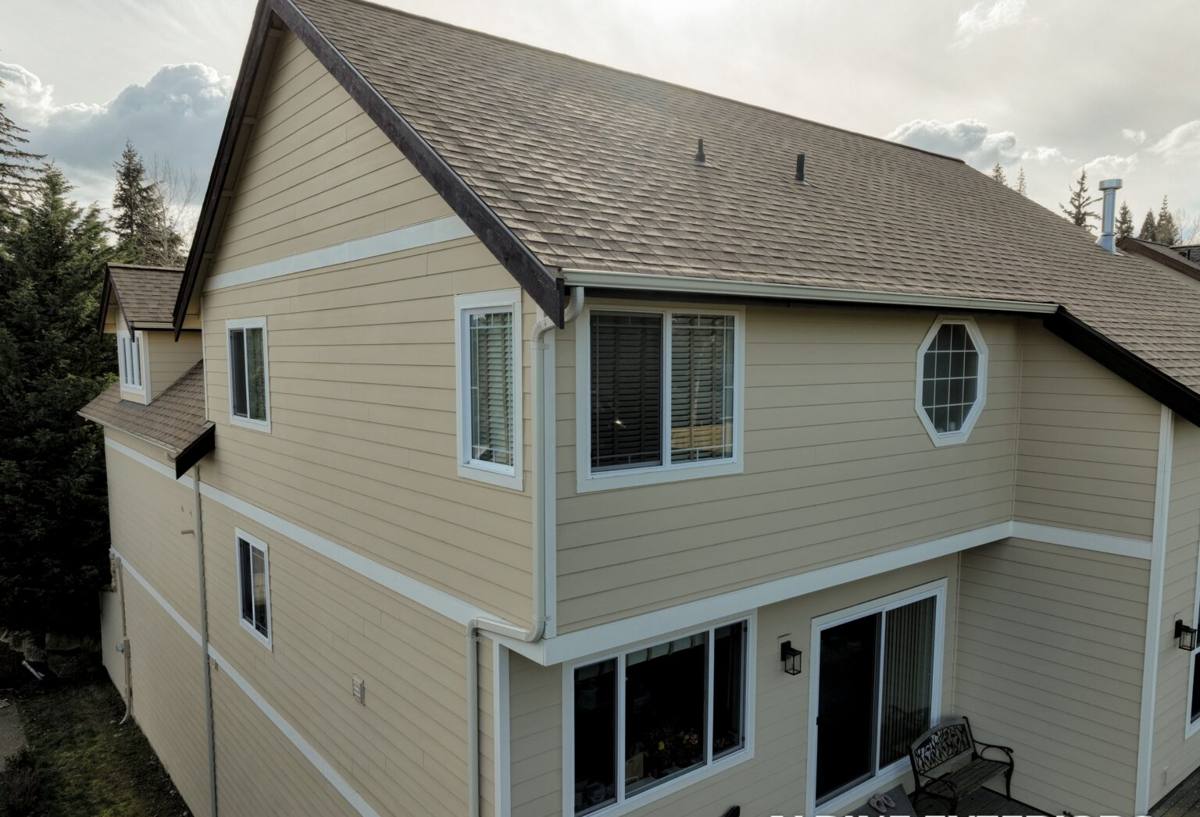
What Correct Siding Installation Actually Involves
Most siding problems we get called out to fix in Bellingham aren't a bad product — they're a rushed or incomplete installation. The material only performs as well as the assembly behind it. A correct install in this climate means:
A Continuous Weather-Resistive Barrier
Housewrap or building paper has to be installed without gaps, properly lapped shingle-style so water sheds downward and out, and taped at every seam. Any staple hole, tear, or shortcut here becomes a path for water to reach the sheathing.
Correct Flashing at Every Penetration
Windows, doors, vents, hose bibs, light fixtures — every single penetration through the siding is a place water wants to get in. Flashing has to be installed in the right order relative to the weather barrier, always shingle-lapped and never taped over in a way that traps water, so it directs moisture out and down instead of behind the siding.
A Drainage Gap Behind the Siding
In a climate that gets this much driving rain, siding needs somewhere for incidental moisture to go. Furring strips or a rainscreen gap let water that does get past the outer layer drain and let the wall assembly dry out between storms instead of staying wet against the sheathing.
Fastening to Manufacturer Spec
Fiber cement siding has a specific nailing pattern, fastener type, and embedment depth. Over-driven nails crack the board's edge and create a moisture entry point; under-driven nails let the board move and eventually work themselves loose. This is one of the most common mistakes we see from installers who don't specialize in the product.
Caulking and Sealant Only Where It Belongs
Modern lap siding is designed to shed water without depending on caulk at every joint. Over-caulking traps moisture behind the board instead of letting it escape — it looks tidy on install day and causes problems two winters later.
Why We Install Only James Hardie Fiber Cement
We made a decision as a company to install one siding system — James Hardie fiber cement — and not vinyl, not LP SmartSide, not primed wood, not cedar. That's not a marketing angle; it's because fiber cement is non-combustible, dimensionally stable through wet-dry cycling, and holds a factory-applied ColorPlus finish that doesn't depend on our crew's paint job for its long-term color retention. In a climate with this much sustained moisture exposure, those properties matter more here than in most parts of the country.
Hardie's HZ5 product line in particular is engineered for regions with cold, wet weather patterns — the kind Whatcom County sees every winter. Standardizing on one system also means our crews install it constantly, know its fastening and flashing requirements cold, and aren't relearning a different set of installation rules on every job.
How Fiber Cement Compares to the Alternatives
Every siding material involves trade-offs. Here's an honest look at how the common options stack up against the conditions Bellingham homes actually face:
| Material | Moisture & Salt Air Behavior | Moss/Algae Resistance | Maintenance | Typical Lifespan |
|---|---|---|---|---|
| James Hardie fiber cement | Dimensionally stable, doesn't swell or rot; factory finish resists coastal weathering | Resists moisture retention; surface treatments extend the interval between cleanings | Occasional wash; no repainting for the life of the ColorPlus finish | 30+ years with proper care |
| Vinyl | Doesn't rot, but can warp or become brittle from UV and temperature swings; seams and J-channels are moisture entry points | Moisture can sit in overlaps and channels | Low, but fading and warping are common over time | 20-30 years, often replaced sooner for appearance |
| Cedar | Naturally moisture-resistant when new, but requires ongoing sealing; end grain and fastener holes are vulnerable | Susceptible without regular treatment; damp climates accelerate this | High — periodic staining/sealing required | 20-40 years with diligent upkeep |
| LP SmartSide (engineered wood) | Treated to resist moisture, but a breach in the coating or a poorly sealed cut edge lets moisture into the wood strand core | Moderate; depends heavily on maintaining the factory coating | Moderate — cut edges and damage need prompt sealing | 25-30 years when maintained correctly |
This isn't a claim that the alternatives are bad products — vinyl, cedar, and engineered wood all have legitimate uses and loyal installers. It's why, given this region's combination of salt air, driving rain, and a long moss season, we standardized our own installation work on fiber cement instead of splitting our crews' expertise across four different systems.
Our Installation Process for Bellingham Homes
- Site and wall assessment — we check existing sheathing condition, look for signs of past moisture intrusion, and note the home's exposure — how much direct rain and salt air different elevations actually see.
- Removal of existing siding — done carefully to inspect the wall behind it before anything new goes up; hidden rot or damaged sheathing gets addressed before we cover it.
- Weather-resistive barrier installation — housewrap installed and lapped correctly, with all seams taped.
- Flashing at every penetration — windows, doors, and any wall-mounted fixtures get flashed in the correct sequence.
- Furring or rainscreen installation — creating the drainage gap this climate calls for.
- Hardie siding installation to manufacturer spec — correct fastener type, spacing, and embedment, with joints and corners detailed to shed water.
- Final inspection and walkthrough — a review of the finished exterior with you before we consider the job done.
What Affects the Cost of a Bellingham Siding Installation
Every home is different, so we won't quote a number without seeing the job, but these are the main factors that move the price up or down:
| Factor | Why It Matters |
|---|---|
| Amount of tear-off and disposal | Removing multiple existing layers or damaged material adds labor and haul-away costs |
| Sheathing repair or replacement | Rot found once old siding comes off has to be addressed before new siding goes on |
| Home shape and trim detail | More corners, dormers, and window/door penetrations mean more flashing and cut work |
| Siding profile chosen | Lap width, board-and-batten, and shingle-style panels vary in material and labor cost |
| Accessibility | Multi-story sections, steep grades, or tight lot lines affect equipment and labor time |
Signs Your Bellingham Home May Need New Siding
- Visible cracking, buckling, or warping on any wall section
- Soft spots when you press on the siding, especially near the bottom edges
- Persistent moss or algae growth that returns quickly after cleaning
- Peeling or bubbling paint, which often points to moisture trapped underneath
- Rising energy bills that suggest the wall assembly is no longer insulating or sealing properly
- Visible gaps at seams, corners, or trim where caulking has failed
Why Hiring a Crew That Already Works in Bellingham Matters
We're based just up the road in Ferndale, and Bellingham is part of the territory we work regularly — not a rare drive-in job. That matters for a few practical reasons: we already understand which elevations in this area take the brunt of the weather off the bay, we're not guessing at how much rain exposure a given wall orientation gets, and we're close enough to stand behind the work without a multi-hour trip if something needs a look. A crew that treats Whatcom County as home ground makes different decisions on flashing details and drainage planning than one installing here for the first time.
If you're weighing a siding project on a Bellingham home, we're happy to take a look and walk you through what we'd actually recommend for your walls and exposure — no pressure, no generic sales pitch. Request a free estimate below and we'll get back to you with straight answers.